
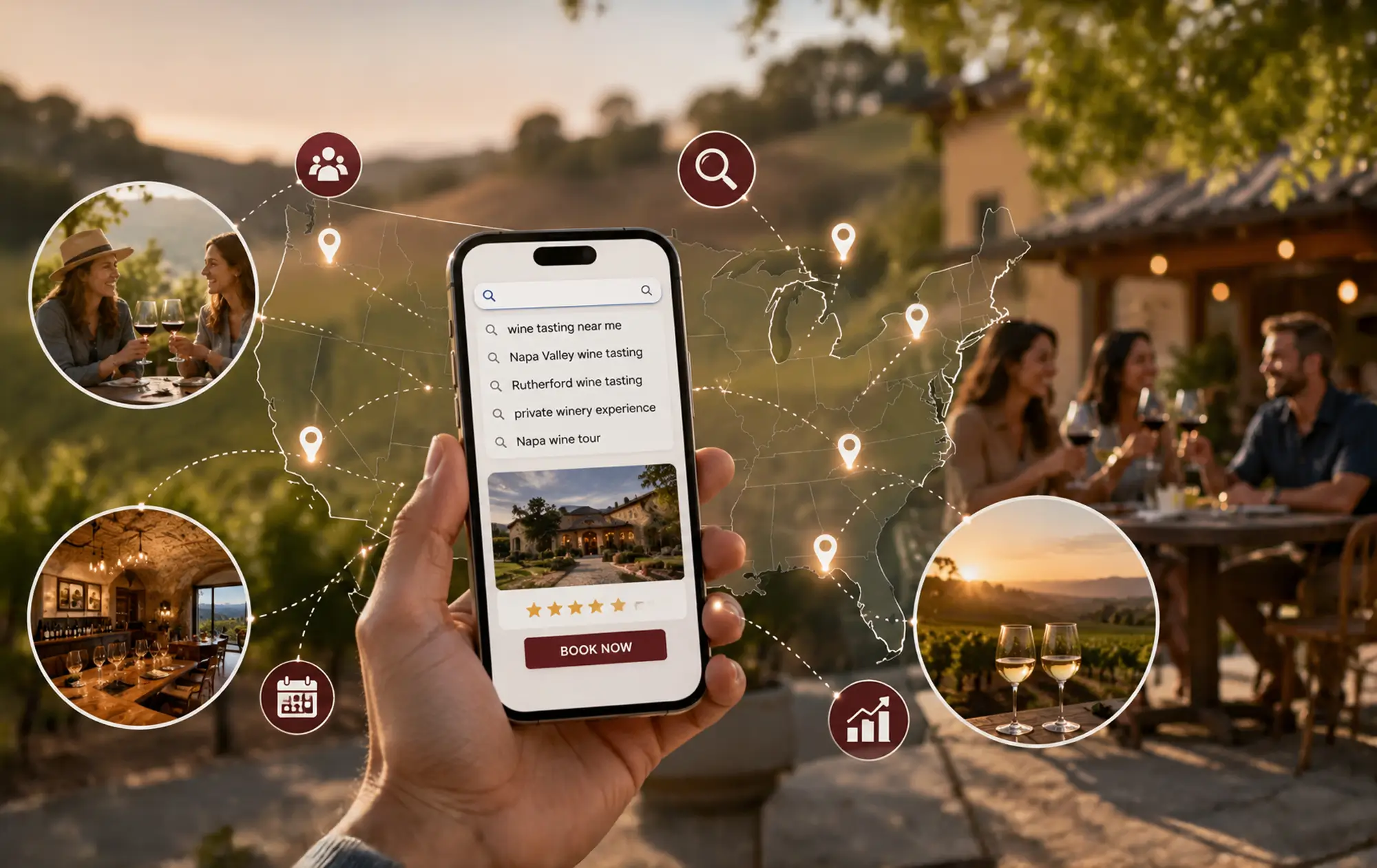
For wineries, tasting rooms, and hospitality brands, every reservation represents more than just a booking. It is an opportunity to create a memorable experience, build customer loyalty, increase wine club memberships, and drive direct-to-consumer sales.
While social media plays an important role in building a brand, the reality is that most consumers don’t book a tasting experience because they saw a social post. They book because they actively searched for one.
That is where paid search becomes one of the most effective digital marketing channels for wineries.
Unlike display or social advertising, Google Search reaches consumers who already have intent.
They are actively searching for things like:
These users aren’t discovering wineries. They’re looking for somewhere to visit today, this weekend, or during an upcoming trip.
Appearing at the top of these searches allows wineries to capture demand at the exact moment someone is ready to book.
Instead of interrupting consumers, paid search meets them exactly where they are in their decision-making journey.
One of the biggest advantages of paid search is intent.
Someone scrolling Instagram may simply be enjoying content.
Someone searching Google for “best wine tasting in Napa Valley” is much closer to making a reservation.
Because of this, paid search typically generates:
For wineries that depend on tasting room traffic, this makes paid search one of the highest-performing marketing investments available.
Successful winery search campaigns involve much more than selecting a few keywords.
High-performing campaigns typically include:
Focus on high-intent searches rather than broad wine-related terms.
Examples include:
These keywords are much more likely to generate reservations than informational searches.
Once someone clicks your ad, the experience should make booking easy.
Landing pages should include:
Every additional click reduces the likelihood of a booking.
Paid search isn’t a “set it and forget it” channel.
Performance improves through ongoing optimization such as:
When campaigns are optimized around reservations instead of clicks, results improve dramatically.
One of the biggest misconceptions is that paid search and social advertising compete with one another.
In reality, they perform best together.
Paid search captures existing demand.
Meta advertising creates new demand.
Brand awareness campaigns on Meta introduce consumers to your winery before they’re actively searching.
Consumers may discover your winery on Instagram or Facebook while planning a future Napa trip. Days or weeks later, when they’re ready to make reservations, they search Google for your brand or tasting experiences.
That’s where paid search converts that awareness into bookings.
This creates a powerful marketing funnel:
Meta Awareness → Brand Recall → Google Search → Website Visit → Reservation
We’ve consistently seen stronger paid search performance when awareness campaigns are running simultaneously.
Benefits include:
Rather than operating independently, the two channels amplify one another.
One example of this strategy in action is our work with Rutherford Hill Winery, a renowned Napa Valley winery known for its elevated tasting experiences.
The objective was straightforward:
At oneteam™, we implemented a two-channel approach designed to generate both demand and conversions.
Google Paid Search
We built highly targeted search campaigns promoting Rutherford Hill’s tasting experiences, directing visitors to their dedicated tasting reservation pages. Campaigns were optimized specifically for online bookings rather than website traffic, allowing Google’s algorithms to prioritize users most likely to complete a reservation.
Meta Brand Awareness
At the same time, we ran Meta campaigns designed to increase awareness among wine enthusiasts and travelers planning visits to Napa Valley. These campaigns showcased the winery’s experiences, scenic estate, and premium brand positioning to keep Rutherford Hill top of mind before consumers began actively searching.
Together, these campaigns created a full-funnel strategy that increased qualified search demand while improving booking performance.
During FY26, the integrated campaign delivered:
While Meta generated broad awareness across more than 2.2 million impressions, Google Search converted that demand into measurable business results.
The search campaign alone generated:
| Channel | Views | Clicks | Visits | Spend |
| Meta | 2.2M | 18.9K | 67 | $10K |
| Google Search | 93.6K | 5.5K | 988 | $12K |
| Total | 2.3M | 24.4K | 1,055 | $22K |
Combined, the campaigns produced 1,055 total bookings, demonstrating how awareness and intent-driven advertising complement one another.
For wineries and hospitality brands, paid search is one of the most effective ways to increase direct bookings because it captures consumers at the exact moment they’re ready to act.
But its impact becomes even greater when paired with upper-funnel brand awareness campaigns.
Meta advertising builds familiarity and creates demand. Google Search captures that demand and converts it into reservations.
Together, they create a marketing ecosystem that delivers measurable business outcomes, from increased website traffic and tasting room visits to stronger direct-to-consumer revenue.
For wineries looking to grow visitation, the question isn’t whether to invest in paid search. It’s how to integrate it into a broader strategy that turns awareness into bookings.
Whether you’re a winery, brewery, distillery, or hospitality brand, oneteam™ develops integrated paid media strategies that combine brand awareness with high-intent search campaigns to drive measurable visitation and revenue.
Let’s talk about growing your next season of bookings.

