
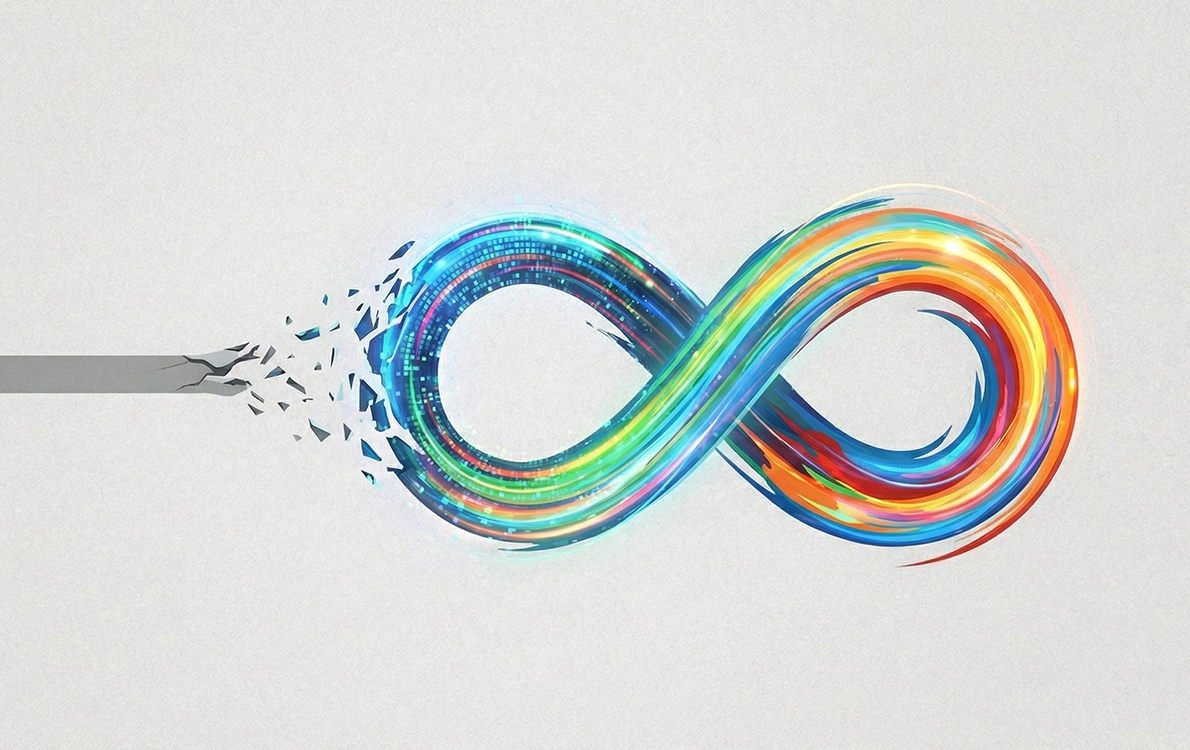
From Linear Process to
Intelligent Feedback Loop
Creativity has always relied on intuition… the spark, the instinct, the sense that an idea might turn into something meaningful. And throughout history, there has always been some form of feedback: reactions from collaborators, early reads, small signals that shape refinement. What has changed today is not the presence of feedback, but the speed, intelligence, and creative potential behind it. The combination of digital marketing, analytics and now, AI has turned feedback from a slow, occasional checkpoint into a living system that evolves alongside every idea… and can actually make it much better.
Rather than following a straight line from concept to execution, modern creativity now loops continuously. A human idea triggers rapid exploration, which leads to new insights; those insights sharpen intuition, which strengthens the next iteration… and the cycle repeats. Technology doesn’t replace the creative director by any means; it becomes the creative director’s closest partner, expanding what’s possible and deepening what’s perceptible. This evolution elevates creatives by helping them move faster, explore wider, and refine earlier, all while amplifying the very instincts that make their work human.
All this said, many organizations still operate in structures built for a slower, more predictable world — long cycles, rigid calendars, heavy approvals, and campaigns that behave like one-time events. Audiences no longer move that way. They shift in real time, constantly influenced by culture, aesthetics, and micro-moments. The real shift brands must solve now is the mismatch between audience speed and creative process speed. Modern feedback loops close that distance and, in the process, reintroduce something the industry has been drifting away from with the advent of generative AI: genuine originality.
When integrated thoughtfully, AI doesn’t diminish creativity… it makes creatives more creatively potent. The tools accelerate exploration, highlight resonance earlier, and can reveal patterns long before a concept goes live. This expanded visibility changes how creatives think and, more importantly, how they work.
Creatives suddenly gain:
These advantages reshape the creative role itself. Designers start thinking more strategically; strategists begin crafting more compelling stories; small teams operate with the reach and agility once reserved for much larger groups. The loop doesn’t flatten creative intuition… it strengthens and can exponentially multiply it.
As a result, the most valuable ideas begin to emerge from the edges rather than the center. Traditional processes often reward safety… ideas that avoid risk, remain familiar, or fit a box. But fast, insight-driven loops encourage something more courageous.
They reward:
This kind of work doesn’t happen when creatives are forced into linear, slow paths. It thrives when teams can experiment freely and boldly, learn quickly, and recognize signal early.
Early validation, in particular, becomes a major unlock. Historically, validating creative thinking early was costly or impractical. Today, AI can make it accessible, instantaneous, and incredibly valuable. It gives teams the ability to recognize direction earlier, differentiate between ideas worth pursuing and ideas worth letting go, and refine thinking while it’s still fluid and imaginative.
It enables:
In this environment, the creative process becomes more liberating, not more restrictive. Teams push further because the loop gives them permission to explore… safely, smartly, and without wasting weeks on concepts that were never going to land.
Across the industry, the organizations that thrive in this next era won’t be the biggest or the loudest. They’ll be the ones that adopt a culture of continuous learning, real-time insight, and creative agility — those who treat ideas as evolving, living entities rather than static deliverables.
The teams that succeed will be the ones who:
That is where creativity thrives: inside the loop, where human intuition meets machine-level insight and becomes something neither could achieve alone.

