
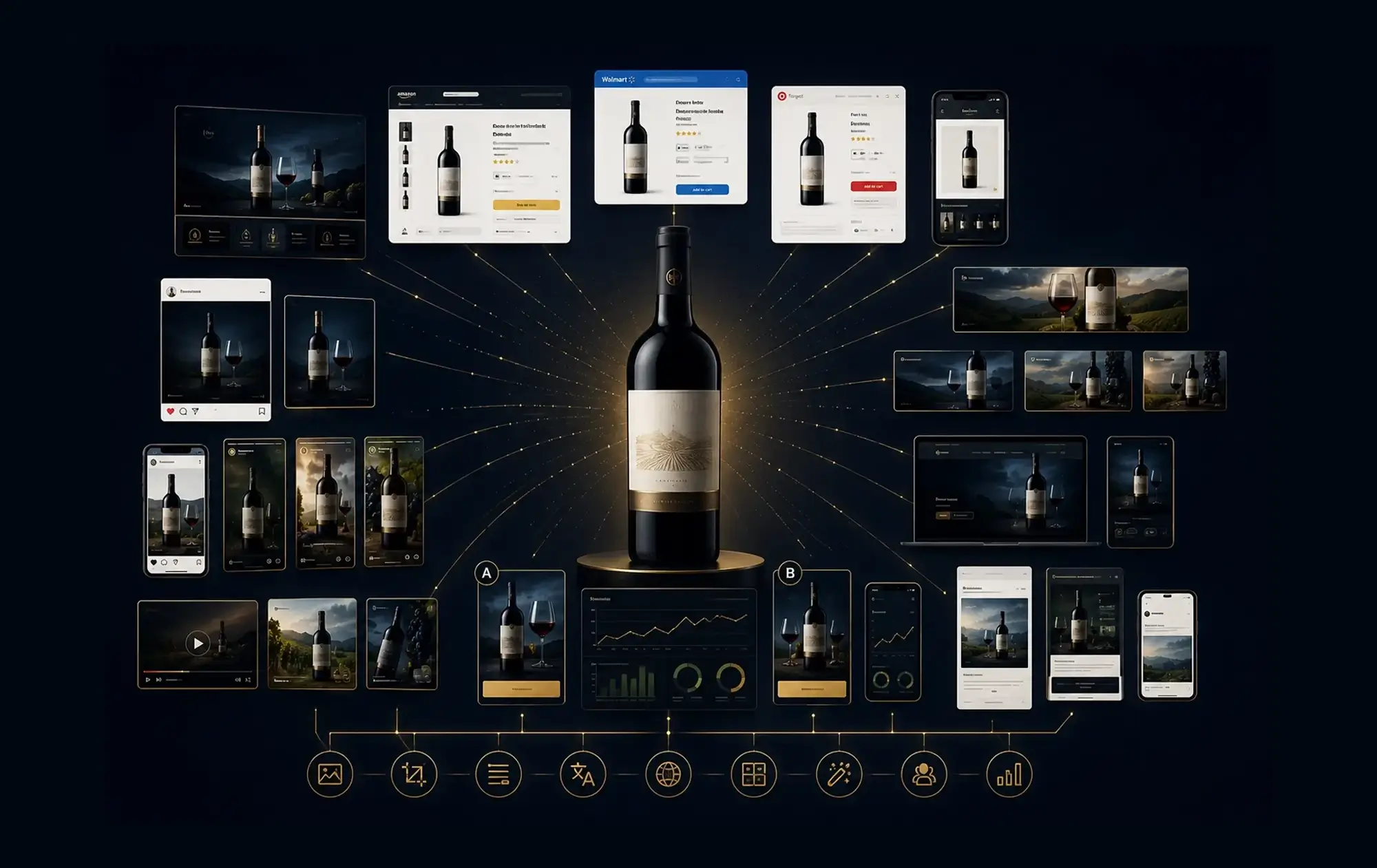
Enterprise brands are quietly rebuilding their content economics using AI. The question isn’t whether this will reach mid-market CPG. It already has. The question is who builds it for you.
L’Oréal doesn’t make news because it creates more content. It makes news because it has built the machine to keep content moving. Continuous output across hundreds of markets, social platforms, and e-commerce environments, adapted rapidly, deployed at scale. Their recent integration of AI into everyday digital advertising production is being covered as a technology story. It isn’t. It’s an economics story.
The real headline: the cost structure of digital content has fundamentally changed. Brands that can’t produce enough usable content to meet the pace of digital advertising aren’t falling behind creatively. They’re falling behind economically.
This isn’t a large brand story. This is a pressure that every CPG brand—at every size—is already feeling.
Here is what the pressure actually looks like for a mid-market brand in wine, spirits, or CPG right now:
The result is a permanent backlog. Content that should be live isn’t. Opportunities to test and optimize go untouched because there’s no bandwidth. Strategy stalls because production never ends.
This is not a creative problem. It is a systems problem. And no traditional agency model is built to solve it.
Stripping away the enterprise language, the model is straightforward. AI is being used to handle the high-volume, repetitive production layer of digital advertising—resizing, reformatting, adapting, and extending existing creative assets across channels and contexts—while human teams maintain control of strategy, brand voice, and final output.
It is not creative replacement. It is production compression. The time and cost between approved creative and live content has been dramatically reduced. The number of usable assets produced from a single shoot or campaign has multiplied. Strategic thinking has improved, because the team isn’t buried in production cycles.
The goal isn’t to produce something altogether new. It’s to produce enough usable content to meet the pace of digital advertising.
For large enterprises, this is now a competitive baseline. For mid-market brands, it has been functionally inaccessible—because it requires not just tools, but structured workflows, governance frameworks, and the expertise to integrate AI into existing brand systems without introducing risk.
A global beauty company has the internal teams, the technology budgets, and the engineering resources to build AI infrastructure from the inside out. They can run pilots, absorb failures, and iterate over time. Most mid-market brands cannot. They have agencies executing campaigns and retainers covering ongoing work. What they don’t have is a partner who builds the system underneath the campaigns, the production infrastructure, the AI-enabled workflows, the feedback loops that make content smarter and more efficient over time.
The brands winning in this environment aren’t producing better individual campaigns. They’re operating with fundamentally better content infrastructure.
oneteam™ is not an agency adding AI tools to the existing model. We build marketing systems… structured, repeatable engines that combine human strategy with AI-enabled execution designed for mid-market brands that need enterprise-grade infrastructure without enterprise-scale overhead.
In practice, that looks like this:
At the center of this is LIFT… our conversion system built to increase revenue performance across product detail pages and digital environments. LIFT is not a campaign. It is not a deliverable. It is a system that learns, optimizes, and compounds. The same principle L’Oréal is applying at global scale, built specifically for mid-market CPG.
| L’Oréal Model | oneteam™ Model | |
| Who it’s for | Global enterprise with internal engineering teams | Mid-market CPG brands |
| How AI is applied | Built internally, integrated into proprietary workflows | Built by oneteam, integrated into client brand systems |
| What it produces | High-volume asset production at global scale | Higher-converting content at CPG-relevant scale |
| Human oversight | Internal creative and brand teams retain control | oneteam strategy and client brand team retain control |
| The outcome | Reduced marginal cost of content at scale | Compounding revenue performance over time |
One of the most important observations from the L’Oréal model is restraint. AI is applied where it reduces friction, not where it reshapes the role of creative teams. That requires a clear framework: where AI is used, how output is reviewed, and who remains accountable for final decisions.
Most mid-market brands don’t have this framework. And most agencies aren’t building it for them. The result is either risk aversion that keeps brands in slower, more expensive production cycles—or unstructured AI use that creates brand inconsistency, approval confusion, and downstream quality problems.
oneteam™ builds the governance layer into every engagement. Defined decision rights. Clear review protocols. Structured feedback loops. Our clients don’t just get output. They get a system they can trust and a process that scales.
The real value is not in any single efficiency gain. It’s in the compounding effect of a system that gets smarter over time. Every optimized PDP, every tested content variation, every approval cycle that moves faster builds toward a performance infrastructure that widens the gap between brands operating on a system and brands still running on a campaign cycle.
The brands building this now will not just produce content faster. They will accumulate performance data, conversion insights, and optimized creative systems that competitors operating on older models cannot close quickly.
That gap is exactly what LIFT is designed to create. Not a better campaign. A better machine.
This is how we think. Let’s talk about what it looks like built for your brand.

